Dentistry for Anxious Patients
Phoenix & North Scottsdale
 If dental anxiety has kept you away from a dentist for months or years, Jerome Riddle DDS in Phoenix, AZ approaches your visit differently than the office that frightened you in the first place. Our practice is built around communication and pacing rather than pharmacological sedation. For most anxious patients, the difference shows up in how the appointment is run, not in what is in the syringe. If dental anxiety has kept you away from a dentist for months or years, Jerome Riddle DDS in Phoenix, AZ approaches your visit differently than the office that frightened you in the first place. Our practice is built around communication and pacing rather than pharmacological sedation. For most anxious patients, the difference shows up in how the appointment is run, not in what is in the syringe.
Anxiety-aware dentistry is part of family dentistry at our office. The same approach carries through to emergency dentistry visits, where dental anxiety often spikes precisely when someone is in pain, and to cosmetic dentistry consultations for patients whose anxiety has kept them from addressing the smile they have wanted for years.
If you specifically need IV or oral sedation to get through dental work, our office is not the right fit. We will say so during your initial call and recommend a sedation-trained practice instead. Most anxious patients, though, do not need sedation. What they need is a different style of appointment.
On This Page
What Is Anxiety-Aware Dentistry?
Anxiety-aware dentistry is a way of running an appointment, not a separate service. Every dental practice claims to be “gentle.” The difference here is structural: we book longer appointments for anxious patients, we agree on a signal system before any instrument touches you, and we stop when you tell us to stop. The clinical work is the same as in any general practice. The way we get there is what changes.
For many patients, the anxiety started somewhere specific. A bad experience as a child, a procedure that hurt more than it should have, a dentist who would not slow down even when asked. The point of anxiety-aware care is to interrupt that pattern by removing the parts that triggered it.
Where Sedation Fits
We do not offer in-office sedation, including nitrous oxide, oral conscious sedation, or IV sedation. That is a clinical scope decision. Sedation requires specific training and Arizona state permits, and our practice has chosen to focus on the non-pharmacological side of anxiety care.
For patients who genuinely need sedation, typically those with severe gag reflex, complex medical conditions, or procedures that cannot reasonably be tolerated awake, we are happy to recommend a sedation-trained practice in the area. The conversation about whether you need sedation should happen before the appointment, not during it.
Your Care Team in Phoenix
Dr. Jerome Riddle, whose bio page details his GPR residency at the UCLA and VA hospitals, describes his approach as “patience and dedication using gentle, yet highly effective techniques.” That is the line that actually matters for anxious patients. With more than two decades of practice in the Phoenix and Scottsdale area, he has worked with patients across the full spectrum of dental anxiety.
Dr. Eric Johnston works alongside Dr. Riddle and graduated from Loma Linda University School of Dentistry in 2017. More on his bio page.
How We Approach Your Visit
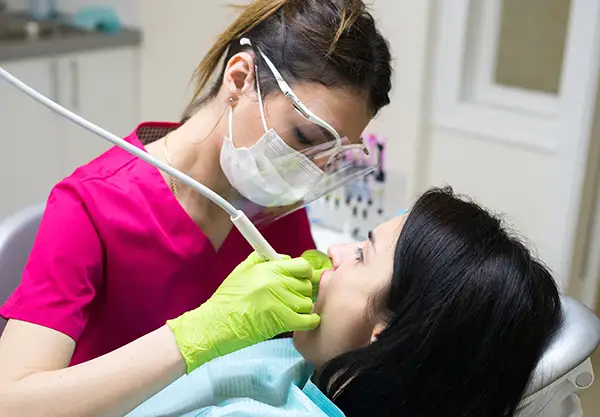 Anxious patients do not need a different exam. They need a different appointment structure. Anxious patients do not need a different exam. They need a different appointment structure.
Before You Come In
We schedule a longer first visit than we would for a non-anxious patient, with no procedure planned for that day unless something is urgent. The call ahead is also longer. Tell whoever answers the phone that you are anxious and what specifically tends to trigger it (the chair, the smell, certain instruments, a past experience), and we make notes that come up at every future visit. The point is to start before you arrive, not after.
If you would like to bring a support person to the first visit, you are welcome to. Some patients want a partner or family member in the operatory; others prefer them to wait in the lobby. Either is fine.
During the Appointment
The first thing we set up is a signal system. A raised hand, a tap on the chair, or a verbal “stop” all work. The point is to give you a way to pause us without speaking through suction and a numb mouth. When the signal goes up, we stop, you take a breath, and we resume only when you are ready.
Pacing matters too. We can break a longer appointment into shorter sections, work in 15-minute increments, or split a single procedure across multiple visits if that is what the case allows. Most patients do not need this, but we want it on the menu before we start.
After the Visit
We close the appointment with a quick debrief. What worked, what did not, and what to change for next time. The notes go into your chart so the next hygienist or doctor knows your specific preferences before they meet you. Anxiety usually gets easier with each visit when the office is paying attention; that is the goal.
What Helps Anxious Patients at Our Office
The substantive things that make a difference for nervous patients are usually concrete, not abstract. Here is what we have found actually moves the needle for our patients in Phoenix:
| • |
Faster digital X-rays are quicker to take and to retake than traditional film, which means less time with sensors in your mouth and less pressure to "hold still" perfectly the first time
|
| • |
Intraoral camera transparency means we show you what we are seeing on a screen before any treatment is recommended, which removes the "I do not know what they are doing back there" feeling
|
| • |
Diagnodent for cavity detection identifies decay without poking the tooth with a probe, which removes one of the steps that triggers anxiety for many patients
|
| • |
Soft tissue laser is used for soft tissue work in place of a scalpel when appropriate, which usually means less bleeding, fewer stitches, and faster healing
|
| • |
Pacing and breaks are built into how we book; most appointments allow more flexibility than they appear to, and we use that flexibility for patients who need shorter sessions
|
| • |
A quieter operatory matters because noise is a frequent anxiety trigger; we keep operatory volume low, do not overlap conversations, and ask before we turn on equipment |
These are the things you can actually feel during a visit. None of them require sedation, and several of them are reasons sedation is not necessary for most patients in the first place.
Why Choose Our Phoenix Office for Nervous Patients
 The honest answer is that we are not a specialty anxiety practice. We are a general and cosmetic dental office that takes anxious patients seriously, books them appropriately, and runs the appointment in a way that respects what they are bringing to the chair. The honest answer is that we are not a specialty anxiety practice. We are a general and cosmetic dental office that takes anxious patients seriously, books them appropriately, and runs the appointment in a way that respects what they are bringing to the chair.
What patients tell us makes the most difference: the appointment ran at the speed they needed, not the speed of a clock; the doctor and hygienist actually paused when they were asked to; the staff knew their preferences from prior visits without having to be reminded each time; and nobody made them feel embarrassed for having been away from a dentist for years.
Many of our anxious patients also overlap with other comfort-priority audiences. We see veterans managing service-related sensitivities and pregnant patients navigating first-trimester nausea or third-trimester comfort, and the same approach scales to those visits as well.
For patients who have wanted to come in but have not been able to, the first conversation is usually a phone call, not an appointment. Call us. Tell us what we are working with. We will tell you honestly whether our office is the right fit for your situation, including the cases where it is not.
Cost and Insurance for Anxious Patient Care
There is no separate fee for anxiety-aware care at our office. The longer first appointments, the signal systems, the pacing, and the comfort measures are part of how we run any visit, not an upcharge.
Treatment costs follow the same fee schedule as any other patient, and we bill your dental insurance the same way. If you have not been to a dentist in years and need a comprehensive exam plus catch-up cleaning, we go through that estimate with you before treatment starts. More on our insurance and financing options.
For patients who postponed care because of cost concerns alongside anxiety, payment plans are available. Cost should not be the second barrier on top of fear.
Schedule Your First Visit
The hardest part of starting back up is making the call. Call Jerome Riddle DDS at 480-991-4410 or request an appointment online. We’re at 7010 E. Chauncey Ln. Suite #140 in Phoenix, AZ 85054. You can also contact us with any questions before booking. Tell us what we are working with, and we will take it from there.
Frequently Asked Questions
Do you offer sedation, nitrous oxide, or "sleep dentistry"?
No. We do not offer nitrous oxide, oral conscious sedation, or IV sedation in our office. Sedation dentistry is a separate category of practice that requires specific training and state permits, and we are not in that category. The two cases where sedation is the right answer are severe gag reflex and certain complex medical procedures, and we will tell you upfront if your case looks like either of those. For everyone else, who make up the majority of anxious patients, communication-first care without sedation is enough.
What if I have not been to a dentist in years?
That is one of the most common situations we see. The first visit is structured around catching up rather than diagnosing everything at once. We do a comprehensive exam, take digital X-rays, and have an honest conversation about what we found. We do not lecture you about how long it has been, and we do not try to schedule extensive treatment in the same visit. Most patients who have been away for years feel better after the first appointment than they expected to.
Can I bring someone with me to the appointment?
Yes, and we encourage it. The most useful role for a support person is during the post-appointment conversation, when we walk through findings and any treatment recommendations. A second set of ears at that stage often catches details that you would otherwise have to remember on your own. If your support person is also driving you home (which we recommend after a high-anxiety first visit even without sedation), let us know when you book so we can plan the appointment around their timing.
What if I have a panic reaction during a procedure?
We stop. The signal system set up at the start of the appointment is for this exact situation. What happens after we stop depends on what you need. Most patients catch their breath and want to keep going after a minute or two. Some need to leave the chair, walk around the lobby, drink some water, and come back. Some need to reschedule entirely. All three are fine, and there is no judgment for any of them. We have rescheduled appointments mid-procedure before, and the next visit usually goes better because we know more about what triggered it.
Can I get through major dental work without sedation?
Most patients can, given the right pacing. Major restorative cases (multiple crowns, full-mouth rehabilitation, extensive periodontal therapy) can usually be split across multiple shorter appointments rather than handled in long single visits. We will be honest with you during the planning stage if your specific case looks like one where sedation would meaningfully help, and we will suggest a referral if it does. More patients think they need sedation than actually need it, in our experience.
Will my appointment cost more because I am anxious?
No, there is no anxiety surcharge. We bill the procedure code performed, the same as for any other patient. The one cost variable that comes up: if you have been away for years and the catch-up plan involves more cleaning visits or more X-rays than a standard recall, that adds to the first-year total (but not to any per-visit fee). Anxiety does not change your fees. More on our insurance and financing options.
What does my first visit look like?
A comprehensive exam, digital X-rays, an intraoral camera tour of your mouth on a screen, and an honest conversation about what we found. About 60 to 90 minutes total, longer than a standard new-patient appointment. No treatment in the first visit unless something is genuinely urgent or you specifically ask for it, since the point of the first visit is the conversation, not the work. More about what to expect at a first visit.
Is there anything I should do to prepare for the appointment?
A few things help. Eat normally before you come; an empty stomach makes anxiety worse for most people. Bring a list of any past dental experiences that triggered the anxiety so we can avoid repeating them. If you take anti-anxiety medication generally and your physician has approved a dose for medical or dental visits, take it as your physician directed (we do not prescribe these). Otherwise, the most important preparation is the phone call where you tell us what we are working with.
|