Cracked Tooth Treatment
Phoenix & North Scottsdale
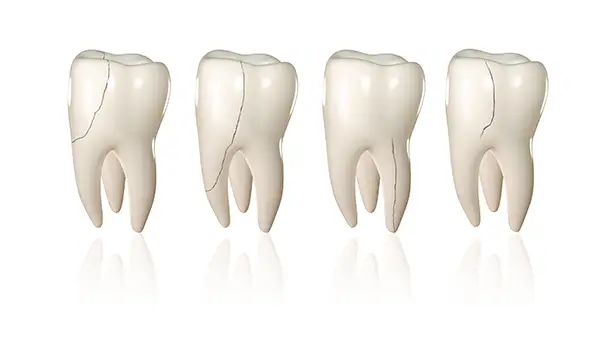 If you have sharp pain when you bite down on something specific, lingering thermal sensitivity, or a tooth that hurts intermittently with no obvious cause, Jerome Riddle DDS in Phoenix, AZ provides cracked tooth treatment to identify and address the structural problem before it gets worse. A cracked tooth is one of the trickiest conditions to diagnose because the crack itself is often invisible on an X-ray, and the symptoms can come and go. If you have sharp pain when you bite down on something specific, lingering thermal sensitivity, or a tooth that hurts intermittently with no obvious cause, Jerome Riddle DDS in Phoenix, AZ provides cracked tooth treatment to identify and address the structural problem before it gets worse. A cracked tooth is one of the trickiest conditions to diagnose because the crack itself is often invisible on an X-ray, and the symptoms can come and go.
Cracked teeth fall on a spectrum from minor surface lines that need no treatment to deep fractures that threaten the tooth’s survival. Where your tooth sits on that spectrum determines what we recommend, and the difference between catching a crack early and waiting can be the difference between keeping the tooth and losing it.
Cracked tooth treatment is part of emergency dentistry at our office. If your tooth is fully broken with a visible piece missing, broken tooth repair services are the right starting point. If a small piece chipped off, see chipped tooth treatment. This page covers the deeper structural condition: a tooth that is cracked but not yet broken apart.
On This Page
What Is a Cracked Tooth?
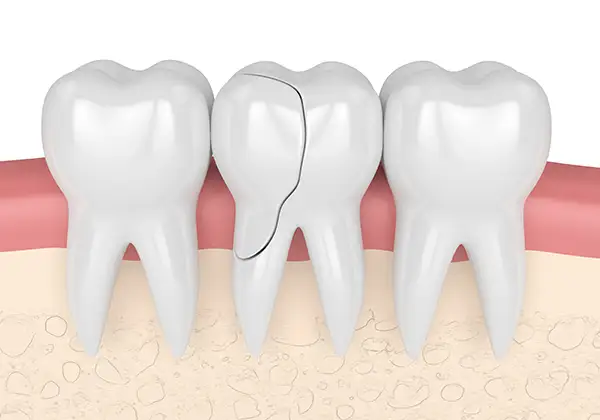 A cracked tooth is a structural fracture that has not yet broken the tooth apart. The crack may stay in the enamel, extend into the dentin (the layer below enamel), reach the pulp (the nerve center), or travel all the way to the root. The deeper the crack reaches, the more extensive the treatment becomes. A cracked tooth is a structural fracture that has not yet broken the tooth apart. The crack may stay in the enamel, extend into the dentin (the layer below enamel), reach the pulp (the nerve center), or travel all the way to the root. The deeper the crack reaches, the more extensive the treatment becomes.
Cracked teeth most commonly occur in molars, particularly back molars and teeth that already have large fillings. The everyday culprits include biting down on something hard (ice, popcorn kernels, an unexpected bone fragment), grinding or clenching habits that fatigue the tooth structure over time, sudden trauma from a sports injury or fall, or a previous filling that has weakened the surrounding tooth.
The Cracked Tooth Severity Spectrum
Five distinct types of cracks exist, ordered roughly from least to most severe:
- Craze lines – tiny surface cracks in the enamel only. Usually painless and cosmetic only.
- Fractured cusp – a portion of the chewing surface breaks off, often around an existing filling. Pain is mild to moderate.
- Cracked tooth (true) – a vertical crack that runs from the chewing surface toward the root. May reach the pulp.
- Split tooth – a true cracked tooth that has progressed and the tooth has separated into two distinct pieces.
- Vertical root fracture – a crack that originates in the root and travels upward, often without symptoms until late.
Diagnosis often requires more than a single X-ray. Many cracks (particularly vertical root fractures and early-stage cracked teeth) are invisible on standard X-rays because the crack runs in the same plane as the X-ray beam. We use a combination of clinical exam, transillumination (a bright light shone through the tooth), bite-stick testing, and 3D imaging when warranted to confirm the diagnosis.
How to Recognize a Cracked Tooth
The hallmark symptom is sharp pain when biting down on a specific spot or releasing the bite, often more intense on release than on the bite itself. Other signs include thermal sensitivity (especially to cold) that lingers for several seconds after the stimulus is removed, intermittent pain that comes and goes with no clear pattern, and discomfort with no visible chip or break. The intermittent quality is what fools many patients into waiting; the pain pattern often ebbs for days before flaring again.
If you are not sure whether what you are feeling is a cracked tooth, a tooth sensitivity treatment consultation can help us identify the cause. Generalized sensitivity has different causes than the localized, bite-triggered pain of a cracked tooth, and the treatment paths diverge.
Your Cracked Tooth Treatment Team in Phoenix
Dr. Jerome Riddle has been treating complex restorative cases in the Phoenix and Scottsdale area for more than two decades. His bio page details his GPR residency at the UCLA and VA hospitals, where general practice residents handle the full range of restorative emergencies. That training matters here because cracked teeth do not announce themselves the way an obvious chip or fracture does; they require a clinician comfortable with the diagnostic puzzle.
Dr. Eric Johnston works alongside Dr. Riddle and graduated from Loma Linda University School of Dentistry in 2017. More on his bio page.
Treatment Options for Cracked Teeth
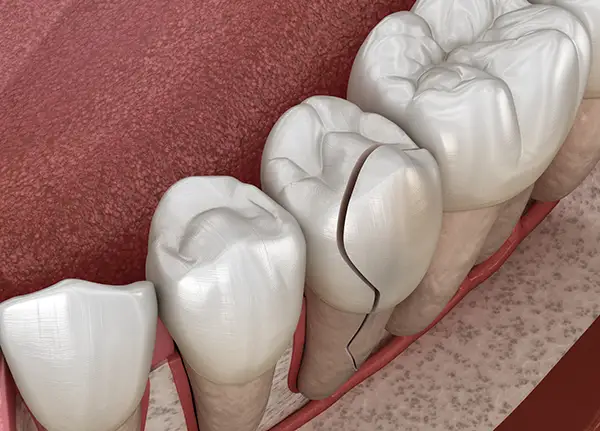 Treatment matches severity. We do not use the same approach for craze lines and split teeth, and recommending the wrong intervention either over-treats a minor crack or under-treats a serious one. Treatment matches severity. We do not use the same approach for craze lines and split teeth, and recommending the wrong intervention either over-treats a minor crack or under-treats a serious one.
Cosmetic Repair for Craze Lines
Craze lines that cause no symptoms typically need no treatment. We monitor them at recall visits and watch for any signs they are progressing. If a craze line is in a visible front tooth and bothers you cosmetically, we can address it with dental bonding or veneer treatment, depending on extent.
Dental Crown for a Fractured Cusp or Contained Crack
For a cusp fracture or a crack contained within the enamel and dentin (no pulp involvement), we recommend a dental crown. The crown holds the remaining tooth structure together, distributes biting forces evenly across the surface, and prevents the crack from progressing. For visible front teeth, porcelain crowns match the natural tooth color while still providing strength; back teeth where chewing forces are higher may use stronger materials. The crown procedure takes two visits: an impression and temporary at the first, the permanent crown at the second, usually 2 to 3 weeks apart.
Root Canal Therapy plus Crown for Cracks Reaching the Pulp
When the crack extends into the pulp, the nerve becomes inflamed or infected, and the tooth needs root canal therapy before we can crown it. The root canal removes the inflamed pulp, cleans and shapes the canal, and seals it. The crown follows because a tooth that has had a root canal becomes more brittle and needs the structural reinforcement a crown provides. Symptoms usually improve significantly after the root canal portion, and we typically place the final crown within a few weeks.
Extraction and Replacement for Split Tooth or Vertical Root Fracture
A tooth that has split into separate pieces, or one with a vertical root fracture, generally cannot be saved. The structural failure is too extensive for a crown or root canal to hold. The right path is tooth extraction followed by replacement to maintain bite function and prevent neighboring teeth from shifting. Common replacement options include a dental bridge or, for multiple teeth, partial dentures. We discuss the right replacement approach with you based on which tooth is involved, the condition of the surrounding teeth, and your preferences.
Why Prompt Attention Matters
The mistake most patients make with a cracked tooth is waiting until the pain becomes constant. Because the symptoms come and go, the temptation is to assume the problem has resolved when the pain ebbs, or to chew on the other side of the mouth and avoid thinking about it.
Cracks do not heal on their own. They progress. A crack contained within the enamel today may extend into the pulp in three months, turning a single crown procedure into a root canal plus crown. A crack that reaches the root may turn an otherwise saveable tooth into an extraction. The window for the simpler treatment closes as the crack deepens.
Beyond the cost difference, the risk to the tooth itself escalates. Once a crack reaches the pulp, the tooth becomes vulnerable to bacterial infection that can spread to the surrounding bone if untreated. A tooth that splits in half is rarely recoverable. The earlier we intervene, the more conservative the treatment and the better the long-term outcome.
If you suspect a cracked tooth, we encourage you to come in within the next few days, not the next few weeks. Even if the pain resolves before the appointment, the diagnosis is still valuable. For grinding-caused cracks, catching them early may mean monitoring plus a custom night guard is the only treatment needed, with no restoration required.
Why Choose Our Phoenix Office for Cracked Tooth Treatment
Cracked teeth are diagnostic puzzles before they are treatment problems. A misdiagnosed cracked tooth gets the wrong treatment, and the wrong treatment fails. Our diagnostic workflow uses transillumination, bite testing on individual cusps, thermal testing, and 3D imaging when warranted to localize the crack and characterize how deep it goes before any treatment is recommended.
Treatment-side, Jerome Riddle DDS is a general and cosmetic dental practice with the full restorative range under one roof. The same office that diagnoses your cracked tooth places the crown, performs the root canal if needed, and handles the extraction and bridge or partial denture if the tooth cannot be saved. You are not bouncing between three offices for sequential care.
For severe or unusual cases (vertical root fractures in molars with multiple roots, for example), we will refer to a specialist when their tools or experience produce a better outcome. We will tell you upfront which path your case calls for.
Cost and Insurance for Cracked Tooth Treatment
The cost of cracked tooth treatment depends entirely on which severity tier the diagnosis falls into. A craze line that needs only monitoring has no treatment cost. A fractured cusp treated with a crown has a different fee than a deeper crack that requires root canal therapy plus a crown, and an extraction with bridge or partial denture replacement is a different category again.
Dental insurance generally covers the major restorative components: crowns, root canals, extractions, and bridges or dentures used to replace lost teeth. Coverage percentages vary by plan, and most plans have annual maximums that may not cover all phases in a single calendar year. Our front office checks your specific coverage and provides a treatment estimate before any work begins. More on our insurance and financing options.
Payment plans are available for treatment that exceeds your annual insurance maximum or for patients without insurance. We treat the cost question as a planning question, not a barrier.
Schedule Your Cracked Tooth Evaluation
The earlier we evaluate a suspected cracked tooth, the more options stay on the table. Call Jerome Riddle DDS at 480-991-4410 or request an appointment online. We’re at 7010 E. Chauncey Ln. Suite #140 in Phoenix, AZ 85054. You can also contact us with any questions before booking.
Frequently Asked Questions
How do I know if I have a cracked tooth versus regular sensitivity?
The hallmark of a cracked tooth is sharp, localized pain when you bite down on a specific spot or release the bite, often worse on release. Generalized sensitivity (cold or hot triggers across multiple teeth, no specific bite trigger) is usually a different issue altogether. If you can reproduce the pain by biting on something hard with one specific tooth and the rest of your teeth feel normal, that points strongly toward a cracked tooth. A consultation can confirm which condition you are dealing with. If your symptoms turn out to be generalized tooth sensitivity or constant toothache rather than bite-triggered cracked tooth pain, the treatment paths diverge.
Will the cracked tooth show up on an X-ray?
Often no, particularly for vertical cracks and root fractures. Cracks that run in the same plane as the X-ray beam are essentially invisible on standard imaging. We rely on clinical exam, transillumination (a bright light shone through the tooth), bite-stick testing on individual cusps, and 3D imaging when warranted to confirm the diagnosis. A negative X-ray does not rule out a cracked tooth.
Should I come in immediately, or can it wait?
If the pain is constant, severe, or accompanied by swelling or fever, come in the same day; that pattern suggests the crack has reached the pulp and the tooth needs urgent care. For intermittent or mild cracked-tooth pain, within a few days is usually fine. Our front office can usually fit a suspected cracked tooth into the same week, sooner if the pain pattern suggests pulp involvement. Waiting weeks or months allows the crack to progress, and the treatment that would have been sufficient at week one may not be sufficient at month three.
Will I need a root canal?
Only if the crack has reached the pulp. We treat cracks contained within the enamel or dentin layers with a dental crown alone. The root canal becomes necessary when the crack extends deep enough to inflame or infect the nerve center, which usually presents as constant or throbbing pain rather than the bite-triggered pain of a contained crack. We confirm pulp involvement during the diagnostic exam before recommending a root canal.
Can a cracked tooth heal on its own?
No. Unlike bone, tooth structure does not regenerate. A crack that exists today will still exist next month, and it tends to deepen over time as you continue to chew with the tooth. The pain may ebb temporarily as the inflammation around the crack subsides, but the crack itself does not close or repair. Treatment is the only path to a stable tooth.
What happens if I leave a cracked tooth untreated?
Three things, in roughly this order. First, the crack progresses deeper into the tooth, eventually reaching the pulp and requiring a root canal in addition to the original crown. Second, if the crack reaches the root, we typically cannot save the tooth and it needs extraction. Third, an untreated crack that reaches the pulp can become infected, and the infection can spread to the surrounding bone. We have seen all three patterns in patients who waited longer than they should have, which is why we encourage prompt evaluation.
Why does the pain come and go?
Tiny movements of the cracked tooth halves under chewing pressure trigger the pain. When you are not chewing on that tooth, the halves stay aligned and nothing stimulates the nerve. The intermittent pattern is also why so many patients delay treatment; the pain seems to resolve, the tooth feels normal for days, and then the symptom flares again. The crack itself is constant; only the symptom is intermittent.
How do I prevent future cracked teeth?
The biggest controllable risk factor is grinding or clenching, which fatigues teeth over time. A custom night guard significantly reduces the load on at-risk teeth during sleep. Avoiding hard foods (ice, hard candies, popcorn kernels) helps too, as does treating large fillings with a crown before the surrounding tooth structure fails. If you have one cracked tooth, you have an elevated risk of another one in the same area, and we will recommend the night guard as a preventive step at your follow-up visit.
|