Toothache Treatment
Phoenix & North Scottsdale
 Toothache treatment in Phoenix, AZ starts with one question: which problem is causing the pain? Jerome Riddle DDS handles tooth pain the same way every time. Find the cause, settle the discomfort, then fix the thing that caused it. Skipping the first step is how patients end up with the wrong tooth treated. Toothache treatment in Phoenix, AZ starts with one question: which problem is causing the pain? Jerome Riddle DDS handles tooth pain the same way every time. Find the cause, settle the discomfort, then fix the thing that caused it. Skipping the first step is how patients end up with the wrong tooth treated.
Tooth pain is a symptom, not a diagnosis. The same throbbing molar can be a cavity that reached the nerve, an infection at the root tip, a crack you cannot see on any image, a gum problem around the tooth rather than in it, or a sinus issue with nothing to do with your teeth at all. Each of those goes a different direction, which is why we will not guess over the phone.
What we can tell you over the phone is whether to come in today or whether tomorrow is fine. Some tooth pain genuinely waits. Swelling, fever, and pain that wakes you up do not, and our same-day emergency dental appointments exist for that second group.
On This Page
What Is Causing Your Toothache
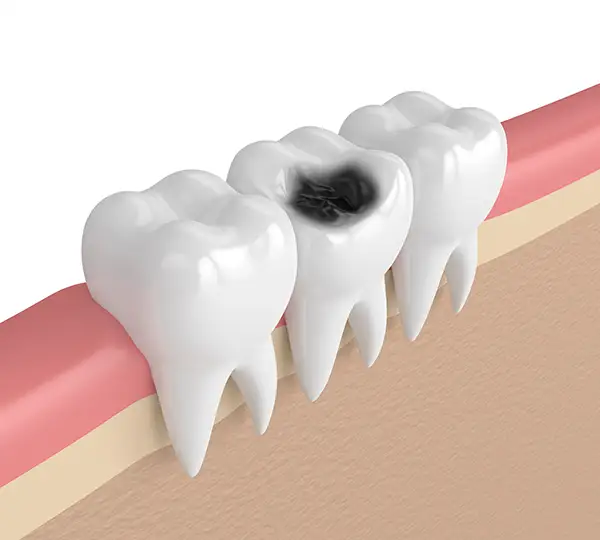 Decay is the most common answer by a wide margin. A cavity sitting in the enamel usually causes nothing at all, which is exactly why it gets missed. Once it reaches the dentin underneath, cold and sweet start to register. Once it reaches the pulp at the center of the tooth, the ache turns constant and stops caring what you eat. That progression is the whole reason we treat tooth decay early rather than watching it. Decay is the most common answer by a wide margin. A cavity sitting in the enamel usually causes nothing at all, which is exactly why it gets missed. Once it reaches the dentin underneath, cold and sweet start to register. Once it reaches the pulp at the center of the tooth, the ache turns constant and stops caring what you eat. That progression is the whole reason we treat tooth decay early rather than watching it.
An abscess is decay’s next chapter. Bacteria that reach the pulp eventually exit through the root tip into the bone, and the pressure that builds there produces the deep, pounding ache patients describe as unlike anything they have felt before. That one is tooth infection treatment territory, and it does not wait.
A cracked tooth behaves differently. The classic sign is a sharp jolt when you release a bite rather than when you apply it, and it tends to show up on a tooth carrying a large old filling. Cracks are frequently invisible on an X-ray, which is one reason the hands-on exam matters as much as the imaging. Our cracked tooth treatment page covers what happens once we find one, while a tooth that has actually broken with a piece missing goes to broken tooth repair services instead.
Three other causes account for most of what is left. Gum disease produces a duller soreness around a tooth rather than inside it, usually with bleeding when you brush, which is why an aching tooth sometimes turns into a periodontal care conversation instead of a restorative one. Nighttime grinding overloads specific teeth and leaves them tender to bite on in the morning, which puts the answer in teeth grinding treatment rather than anything restorative. And upper back teeth sit close enough to the sinus floor that a sinus infection can make two or three of them ache at once, usually with a pressure that shifts when you bend forward.
What the Pain Pattern Tells Us
How the pain behaves narrows the list before we pick up a single instrument. Cold that stings for a second or two and then vanishes usually points to exposed root surface or early decay, and that often lands in tooth sensitivity treatments rather than anything more involved. Cold that lingers for 30 seconds after the ice water is gone points at the pulp itself. Pain on the release of a bite suggests a crack. Spontaneous throbbing with no trigger at all, especially at night, suggests the nerve is inflamed past the point where it recovers. Pressure across several upper teeth at once, alongside congestion, points away from the teeth entirely.
When a Toothache Needs Same-Day Care
Call today rather than tomorrow if any of the following is true:
- Swelling anywhere in the face or jaw – Including under the chin, and including cases where the tooth itself feels better than it did yesterday.
- Fever or feeling generally unwell – That combination suggests infection that has moved beyond the tooth.
- Pain that wakes you up – Or pain that over-the-counter medication has stopped touching.
- A bad taste or drainage – Usually means an abscess found its own way out, which relieves the pressure without treating anything.
- Pain that started with an injury – A blow to the mouth reorders the priorities completely.
Skip us and go to an emergency room if swelling is affecting your breathing or swallowing, if it is spreading toward your eye or down your neck, or if you cannot open your mouth normally. In those situations the airway matters more than the tooth does.
A dull ache only while brushing, or cold sensitivity that fades within a couple of seconds, is usually fine to schedule normally. So is a tooth that got sore after a filling last week and has been slowly improving since. A tooth knocked completely out of its socket runs on a far tighter clock than any of these, roughly 30 minutes, and our knocked-out tooth treatment page walks through what to do inside that window. Toothaches are the most common reason patients call us on short notice, sitting alongside the injuries and broken restorations covered under our emergency dentistry services.
Your Toothache Care Team in Phoenix
Dr. Jerome Riddle examines and diagnoses comprehensively before recommending anything, which sounds like a small thing until you consider how tooth pain actually presents. Referred pain is common. An upper molar and the lower molar directly beneath it can feel identical to the patient, and only testing sorts them out. His training runs from Northern Arizona University for his bachelor’s degree, to the University of Southern California for dental school, to a general practice residency across the UCLA and VA hospitals. His bio page fills in the rest.
He has practiced in this area for more than 20 years and lays out treatment options against your medical history, what is genuinely necessary, and what fits your budget, rather than presenting one plan and waiting for a yes. With an aching tooth there is often more than one defensible route, and which one is right depends on how much sound tooth structure is left.
Dr. Eric Johnston reached Loma Linda University School of Dentistry by way of a biology degree in Chattanooga and graduated in 2017, with the rest of that path on his bio page. He likes learning new techniques and putting them to work, which suits a back molar that is more old filling than tooth. Those teeth need two things at once: the discomfort has to end, and the repair has to survive years of chewing afterward.
What Happens at Your Toothache Appointment
 We start by asking you to point. Which tooth, when it started, what makes it worse, whether it wakes you up, and whether anything makes it better. That two-minute conversation rules out more possibilities than any single test that follows it. We start by asking you to point. Which tooth, when it started, what makes it worse, whether it wakes you up, and whether anything makes it better. That two-minute conversation rules out more possibilities than any single test that follows it.
Finding the Source
A digital X-ray of the area shows decay between teeth, bone loss around the roots, and the dark shadow at a root tip that signals an abscess. Then we test the tooth directly. Tapping it tells us whether the ligament around the root is inflamed. A cold stimulus tells us whether the nerve is alive, dying, or already gone. Biting on a wedge, one cusp at a time, finds cracks that no image will ever show. On the biting surfaces of back teeth we also use the Diagnodent laser, which reads laser fluorescence inside the mineral structure of the tooth and catches decay hiding in deep grooves before it is visible or large enough to cast a shadow.
Getting the Discomfort Under Control
Comfort comes before the long-term fix. Depending on what we find, that can mean opening the tooth to release pressure from an abscess, clearing out the decay irritating the nerve and placing a soothing temporary filling, adjusting a restoration sitting a fraction too high, or flushing out a food impaction that has been inflaming the gum tissue for a week. Whether we can settle the pain the same day depends entirely on the cause, and we will say so plainly before we start rather than after. If dental anxiety is part of why the call kept getting postponed, we pace visits differently for anxious patients, and that applies to urgent appointments as much as routine ones.
Where Treatment Goes From There
Most toothaches resolve into one of four routes. Shallow to moderate decay becomes a dental filling. Decay or a crack that has reached the pulp becomes a root canal, generally followed by a crown that keeps the remaining tooth from splitting. Gum-related pain becomes periodontal treatment plus a change to how that area gets cleaned at home. A tooth with too little structure left to rebuild becomes a tooth extraction and a conversation about replacing it. You will know which route your tooth is on before you leave, along with what happens if you wait.
Why Treating a Toothache Early Pays Off
Tooth pain that stops on its own is not good news. When a nerve finally dies, the pain often goes quiet for days or weeks before the infection reaches the bone and comes back worse. Patients who wait out that quiet stretch usually arrive needing more treatment than they would have needed three weeks earlier.
| • |
More of your tooth survives - Decay caught in the dentin becomes a filling. The same decay two months later can mean a root canal and a crown.
|
| • |
The infection stays where it is - Bacteria confined to a tooth are a dental problem. Bacteria that reach the jaw and spread become a medical one.
|
| • |
Treatment takes less time and less money - One filling appointment and a multi-visit root canal with a crown are not in the same category, in either chair time or cost.
|
| • |
You sleep again - Dental pain peaks at night because lying down increases blood flow to the head and raises pressure inside an inflamed tooth. The sleep debt is the part patients say wore them down most.
|
| • |
Nothing else has to shift - A tooth you keep is a tooth still holding your bite, your neighboring teeth, and your jaw joint where they belong. |
Grinding-related aches deserve their own mention, because they are the ones patients most often decide to live with. Teeth that feel dull and tender in the morning and settle down by noon usually mean you are clenching overnight, and a custom night guard addresses the cause rather than the symptom.
Why Phoenix Patients Bring Tooth Pain to Us
Diagnosis is what separates a good toothache visit from a frustrating one. Digital X-ray, an intraoral camera, a Diagnodent laser, and 3D imaging all live in this building, so the tests that identify the cause happen in one sitting instead of across a referral and a second appointment. The intraoral camera earns its keep here specifically: seeing the cracked cusp or the shadow under an old filling on a screen turns a recommendation into something you can evaluate for yourself.
Coverage is the other piece. With two dentists on staff, one of them practicing in this area for more than 20 years, someone calling at 8:30 in real discomfort is not automatically waiting a week for an opening. Our office sits at 7010 E. Chauncey Ln. Suite #140, on the Phoenix and North Scottsdale line in the 85054 zip, which puts most of our patients 10 or 15 minutes out rather than across the valley.
We are also straightforward about the aches a dental chair cannot solve. Sinus-driven pain in the upper back teeth goes back to your physician, because no filling will fix it, and telling you that on day one is more useful than treating a tooth that was never the problem.
A good share of the toothaches we treat trace back to something a routine dental exam would have caught while it was still small and painless. That is the argument for the boring appointments.
Toothache Treatment Cost and Insurance
Cost matters, and it matters more when the visit was not on your calendar this week. The breakdown is usually three parts. The emergency exam and imaging are one. Whatever we do to settle the discomfort that day is a second. The definitive treatment, whether that is a filling, a root canal and crown, or an extraction, is the third, and it is the one that varies most.
What moves that last number is how deep the problem got before you came in. Decay caught in the dentin and the same decay sitting in the pulp fall into two different categories entirely. That is not a sales line, it is the reason we push people not to wait. Publishing a number for a tooth nobody has looked at yet would be guessing. What you get instead is a written estimate before treatment starts.
Dental plans typically cover emergency exams and imaging at a high percentage and restorative work at a lower one, with an annual maximum sitting over the whole thing. Aetna, Cigna, Delta Dental, and MetLife are among the carriers we work with, and the full list sits on our financial and insurance page. Payment plans are available when insurance does not cover the full amount. Call 480-991-4410 before your visit and our front office team will verify what your plan covers.
Schedule Your Toothache Appointment
If a tooth is keeping you up, call 480-991-4410 and describe what it feels like. We are at 7010 E. Chauncey Ln. Suite #140 in Phoenix, AZ 85054. For an ache that is annoying rather than urgent, our Request an Appointment page is the easier route. Questions before you book go through our Contact page.
Frequently Asked Questions
Why does my tooth only hurt when I bite down?
The timing within the bite is the clue. Pain the instant you press down usually means a filling or crown is sitting slightly high, which is a five-minute adjustment. Pain when you let go points at a crack, because the two halves of the tooth flex apart and then snap back against the nerve. Try biting on a rolled-up paper towel, one cusp at a time, and note which corner reproduces it. That detail saves us real time at the appointment.
What can I take for tooth pain until my appointment?
Over-the-counter anti-inflammatory pain relievers tend to work better on dental pain than plain acetaminophen, because most toothaches involve inflammation rather than pain alone. Follow the label, and check with your physician or pharmacist first if you are pregnant, take blood thinners, or have stomach, kidney, or liver concerns; for a child, ask us or your pediatrician rather than scaling down an adult dose. A cold compress on the outside of the cheek helps, and propping your head up at night helps more than people expect. One thing not to do: never hold an aspirin tablet against the gum. It burns the tissue and does nothing for the tooth.
Does a toothache always mean I need a root canal?
No, and most do not. The dividing line is whether the nerve can still recover. A nerve that is irritated but healthy calms down once we remove the decay pressing on it, and a filling ends the story. A nerve that has been inflamed too long will not settle no matter what we place over it, and that is the tooth that needs a root canal followed by a dental crown. Lingering pain after cold and spontaneous throbbing at night are the two signs that push a tooth into the second group.
Can a sinus infection cause tooth pain?
Yes, and it is more common than most patients realize. The roots of the upper back teeth sit directly against the sinus floor. Three signs point that way: several upper teeth ache at once rather than one, the pressure changes when you bend over or step down hard on your heels, and you have had congestion or a cold recently. Sinus-origin tooth pain needs a physician, not a filling, and we would rather send you there than treat a tooth that was never the source.
My X-ray looked normal but my tooth still hurts. What now?
A normal image narrows the field rather than closing the case. Cracks, early pulp inflammation, and bite problems are all invisible on an X-ray by nature, so the next step is testing rather than more imaging. That means cold testing, tapping, individual cusp loading, and checking how your teeth come together. Sometimes the honest answer at the first visit is that we are watching a tooth for a few weeks, and we would rather say that than treat the wrong one.
Will a cleaning help if my gums are what is aching?
Often yes, and it depends on how deep the inflammation goes. Soreness from plaque and tartar at the gumline usually responds to a standard dental cleaning plus a few weeks of consistent flossing. Soreness coming from pockets deeper than about four millimeters needs a deep cleaning below the gumline instead, because a routine polish cannot reach the tartar causing it. We measure those pockets during the exam, so you are not guessing which category you are in.
Does dental insurance cover a toothache visit in Phoenix?
Most plans cover the emergency exam and imaging at a high percentage, then cover the treatment that follows at a lower one. Two details catch patients out. Newer policies sometimes carry a waiting period on major work such as crowns, even while covering the exam right away. And annual maximums reset on a specific date, so splitting a treatment plan across that date occasionally saves a meaningful amount. Our front office team checks both before we schedule.
How quickly can I be seen for tooth pain at your Phoenix office?
Our office reserves time each day for urgent cases, so same-day is realistic in most instances when you call early. Describe the symptoms rather than just asking for the next opening, because swelling, fever, and sleepless nights move you up the list. If the pain started overnight, call Jerome Riddle DDS first thing rather than waiting to see whether it settles on its own, since the urgent slots fill from the top of the day.
|